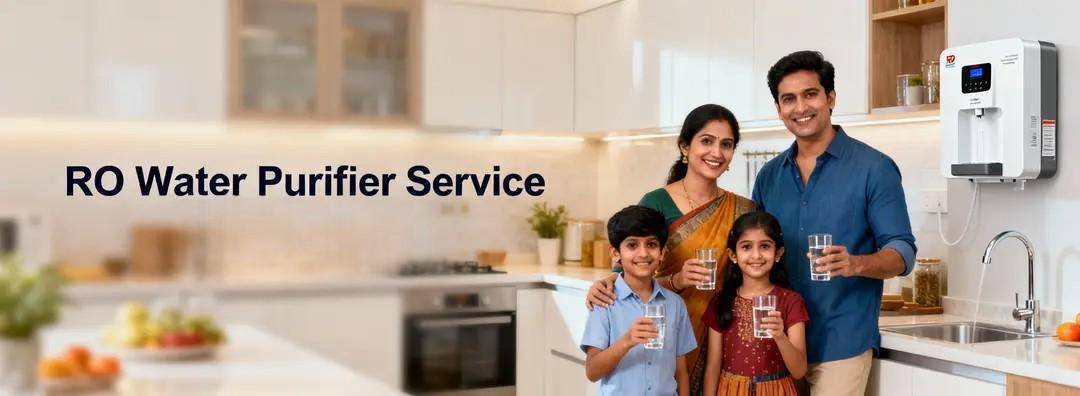
Water Purifier Service | RO Repair
Premium Service Package
Select Service Type
Choose your package

Membrane & Filter Replacement
- RO membrane replacement
- Pre filter replacement
- Cartridge filter replacement

Breakdown & Emergency Repair
- RO plant not producing water
- Low flow / high TDS problem
- High pressure pump failure
- PLC / control panel fault
- Valve, sensor, solenoid issues
- Leakage & piping burst issues

Chemical Services
- Antiscalant dosing & supply
- Membrane cleaning chemicals (CIP)
- Disinfection & sanitization
- Chemical consumption audit
- Chemical optimization (cost saving)

Installation & Commissioning Services
- New Industrial RO / STP / ETP plant installation
- Piping, electrical & panel wiring
- Trial run & performance testing
- Operator training (basic operation & safety)

Preventive Maintenance / AMC Services
- Monthly / Quarterly / Annual AMC
- Filter & membrane health check
- Pressure, flow & TDS monitoring
- Chemical dosing system checking
- Cleaning of tanks & vessels
- Breakdown-free operation assurance

Your Cart
Ready to checkout
Your cart is empty
Add some items to get started
9000 LPH Industrial RO Plant – High-Capacity Water Treatment
A 9000 LPH (Liters Per Hour) Industrial RO Plant is designed for facilities that require a dependable supply of treated water throughout the day. With a high production capacity, this type of RO system can support manufacturing plants, food and beverage units, pharmaceutical facilities, textile industries, hospitals, hotels, institutions, and other commercial operations.
Large-capacity RO plants operate through several interconnected treatment stages. Changes in raw-water quality, membrane fouling, pump performance, filter condition, pressure variation, or electrical faults can affect overall plant output. Regular 9000 LPH RO plant service helps maintain system performance and identify potential problems before they result in extended downtime.
At RO Service & Sales, we provide technical support for 9000 LPH industrial RO plants, including installation, commissioning, preventive maintenance, breakdown repair, membrane servicing, pump inspection, filtration maintenance, troubleshooting, and AMC support.
Key Features of a 9000 LPH Industrial RO System
- 9,000 LPH treatment capacity – suitable for applications requiring a high volume of treated water
- Pre-treatment integration – sand, carbon, softening, micron filtration, and other stages can be configured according to feed-water conditions
- Industrial RO membrane system – designed to reduce dissolved salts and other contaminants from the treated-water stream
- Automated operation – control systems can monitor important plant functions and provide operational protection
- Heavy-duty components – suitable pumps, membrane housings, valves, pipelines, and filtration equipment can be selected according to the plant design
- Performance-oriented configuration – system parameters can be planned around raw-water characteristics and required output
- Serviceable industrial design – components can be inspected, maintained, cleaned, repaired, or replaced when required
Applications of 9000 LPH RO Plants
A 9000 LPH RO plant can be used wherever a continuous supply of purified or treated water is required.
Typical applications include:
- Food and beverage production facilities
- Pharmaceutical and chemical industries
- Textile and garment processing units
- Dairy and food-processing plants
- Hotels and hospitality properties
- Hospitals and healthcare facilities
- Manufacturing and engineering units
- Institutional campuses
- Commercial water-treatment facilities
- Boiler and process-water applications
- Industrial utility-water systems
The required RO configuration depends on the source-water characteristics and the quality requirements of the final application.
Our 9000 LPH RO Plant Services
RO Service & Sales provides support throughout the operating life of a 9000 LPH industrial RO system.
- Plant Installation & Commissioning – professional setup, connections, testing, and initial operational checks
- Preventive RO Maintenance – scheduled inspection of membranes, pumps, filters, valves, and control components
- Breakdown Repair – troubleshooting for unexpected plant failures and performance issues
- Membrane Inspection & Replacement – assessment of membrane condition, fouling, scaling, and declining output
- High-Pressure Pump Service – inspection of pump pressure, motor performance, vibration, leakage, and related components
- Filter & Pre-Treatment Service – maintenance of filtration and pre-treatment stages to protect the RO section
- Electrical & Control Panel Support – troubleshooting of sensors, electrical connections, automation, and control components
- Industrial RO AMC – planned maintenance programs for businesses that require regular technical support
Common 9000 LPH RO Plant Problems
Even a properly designed industrial RO system can develop operational issues over time. Feed-water changes, inadequate pre-treatment, component wear, scaling, fouling, or incorrect operating conditions may affect performance.
Professional 9000 LPH RO service can help investigate problems such as:
- Decline in treated-water production
- Increase in permeate TDS
- Reduced membrane performance
- High or unstable operating pressure
- Excessive membrane fouling
- Scaling inside the RO system
- Cartridge filter choking
- High-pressure pump failure
- Water leakage from connections
- Unusual pump vibration
- Flow-meter or pressure-gauge issues
- Dosing-system problems
- Electrical or control-panel faults
- Automatic shutdown issues
- Irregular water recovery
A complete system inspection can help determine whether the problem is related to pre-treatment, membranes, pumps, hydraulics, electrical components, or operating conditions.
9000 LPH RO Installation & Commissioning
Correct installation is essential for achieving stable operation from a high-capacity RO plant. Our 9000 LPH RO installation service covers the major stages required to put the system into operation.
Installation Support Includes:
- Site and installation-area assessment
- RO plant positioning
- Feed-water pipeline connection
- Pre-treatment integration
- High-pressure pump connection
- Membrane housing setup
- Product-water and reject-water connections
- Electrical and control-panel connections
- Instrument and sensor checking
- Leakage inspection
- Pressure and flow testing
- Trial operation
- Commissioning assistance
The actual installation procedure depends on the equipment configuration, site infrastructure, water source, and treatment requirements.
9000 LPH RO Membrane Maintenance
The membrane section is central to RO purification performance. Reduced permeate flow or increasing treated-water TDS can indicate that the membrane system requires investigation.
Our 9000 LPH RO membrane service can involve:
- Monitoring permeate flow
- Checking feed and operating pressure
- Measuring treated-water TDS/conductivity
- Inspecting membrane performance
- Identifying fouling and scaling symptoms
- Evaluating cleaning requirements
- Checking membrane housings
- Inspecting seals and O-rings
- Supporting membrane replacement
Membrane cleaning or replacement should be considered after evaluating actual operating data and the condition of the RO system.
9000 LPH RO Pump Service
A high-pressure pump must deliver suitable pressure and flow for the RO membrane section. Pump-related issues can affect the performance of the complete plant.
Our 9000 LPH industrial RO pump maintenance can cover:
- Pressure checking
- Motor inspection
- Electrical connection checking
- Mechanical inspection
- Leakage detection
- Vibration monitoring
- Abnormal-noise investigation
- Coupling inspection
- Performance troubleshooting
Routine pump inspection can help identify developing mechanical or electrical issues before they cause a major interruption.
9000 LPH RO Preventive Maintenance
Preventive maintenance is an important part of industrial RO plant management. Instead of waiting for production to fall or a component to fail, scheduled service allows important parts of the system to be monitored regularly.
A typical 9000 LPH RO maintenance program may include:
- Pre-treatment inspection
- Sand and carbon filter checking
- Cartridge filter inspection
- Membrane performance monitoring
- High-pressure pump inspection
- Pressure and flow monitoring
- Valve and pipeline inspection
- Dosing-system checking
- Electrical-panel inspection
- Sensor and instrument checking
- Leakage inspection
- Cleaning recommendations
- Overall plant performance assessment
The maintenance schedule should be determined according to operating hours, feed-water quality, plant usage, and equipment condition.
9000 LPH Industrial RO AMC
An Industrial RO AMC provides scheduled technical support for businesses that depend on continuous water treatment. An AMC can help organize preventive maintenance and reduce dependence on emergency breakdown servicing.
Depending on the agreed service scope, an AMC may include:
- Periodic plant inspection
- Preventive maintenance visits
- Membrane performance checks
- Pump and motor inspection
- Filter condition monitoring
- Control-panel inspection
- Leakage and pipeline checks
- Cleaning recommendations
- Breakdown assistance
- Maintenance reporting and recommendations
AMC frequency and coverage can be planned according to the operational requirements of the 9000 LPH RO plant.
Why Choose RO Service & Sales
1. Industrial RO-Focused Service
Our service approach is designed around the requirements of commercial ro plant service and industrial water-treatment systems, including high-capacity RO plants.
2. Complete Component Inspection
We can inspect the complete RO system rather than focusing on a single component, helping identify issues across filtration, membranes, pumps, hydraulics, and controls.
3. Preventive Maintenance Support
Regular servicing helps monitor important components and identify potential performance issues at an early stage.
4. Membrane & Pump Expertise
Membranes and high-pressure pumps are critical to RO performance. Proper inspection of these components can help maintain stable operation.
5. Breakdown Troubleshooting
Technical troubleshooting is available for problems involving water production, pressure, TDS, leakage, pumps, membranes, filtration, and control systems.
6. AMC Maintenance Programs
Businesses can opt for planned industrial RO AMC support according to their plant usage and maintenance requirements.
7. Pan-India Service Network
Service availability can be arranged across applicable locations in India for industrial RO maintenance, repair, installation, and technical support.
Industries Using 9000 LPH Industrial RO Systems
High-capacity RO systems can support a wide range of industrial and commercial applications, including:
- Pharmaceutical manufacturing
- Food processing
- Beverage production
- Dairy operations
- Textile processing
- Chemical industries
- Hospitals
- Hotels
- Manufacturing facilities
- Institutional campuses
- Commercial water-treatment units
- Industrial process-water applications
The final plant configuration should be selected according to feed-water analysis, required treated-water quality, daily consumption, and application-specific requirements.
Frequently Asked Questions
Q1. What is a 9000 LPH RO plant?
A 9000 LPH RO plant is a high-capacity reverse osmosis system designed to process water at a nominal capacity of approximately 9,000 liters per hour, subject to system design and operating conditions.
Q2. What services are available for a 9000 LPH RO plant?
Services can include installation, commissioning, preventive maintenance, breakdown repair, membrane inspection, pump servicing, filter maintenance, electrical troubleshooting, and industrial RO AMC.
Q3. What can cause low production from a 9000 LPH RO plant?
Low production may be associated with membrane fouling, scaling, inadequate feed pressure, blocked filters, pump performance issues, temperature changes, or other operating conditions. Proper diagnosis is required to identify the cause.
Q4. How can I identify an RO membrane performance problem?
Reduced permeate flow, increasing treated-water TDS, changes in pressure, and declining system performance can indicate a membrane-related issue. Operating data should be checked before deciding on cleaning or replacement.
Q5. Does RO Service & Sales provide 9000 LPH RO AMC?
Yes. AMC support can be arranged for scheduled inspections, preventive maintenance, component checks, and breakdown assistance according to the agreed service requirements.
Q6. Can an existing 9000 LPH RO plant be serviced?
Yes. Existing plants can be inspected for membrane condition, pump performance, filtration issues, leakage, pressure problems, electrical faults, and other operational requirements.
Q7. What is checked during 9000 LPH RO maintenance?
Maintenance can involve pre-treatment equipment, cartridge filters, membranes, pumps, pressure gauges, flow meters, valves, pipelines, dosing equipment, electrical components, sensors, and control systems.
Q8. Do you provide industrial RO pump repair?
Yes. Industrial RO pump service can include pressure checking, motor inspection, electrical testing, vibration and noise assessment, leakage inspection, and mechanical troubleshooting.
Q9. Is installation service available for a 9000 LPH RO plant?
Yes. Installation support can include plant positioning, pipeline connections, pre-treatment integration, pump connections, electrical work, membrane setup, testing, and commissioning.
Q10. How often should a 9000 LPH RO plant undergo maintenance?
There is no single schedule suitable for every plant. Maintenance frequency depends on raw-water quality, operating hours, pretreatment efficiency, membrane performance, and plant configuration.
Q11. Can high TDS in treated water be repaired?
High permeate TDS requires diagnosis. Possible causes can include membrane deterioration, sealing problems, operating-pressure changes, feed-water changes, or other system issues. A technical inspection can determine the appropriate corrective action.
Q12. How can I request 9000 LPH industrial RO service?
Provide the plant capacity, location, current problem, recent maintenance information, and available technical details. The service requirement can then be assessed and the appropriate maintenance, repair, or AMC support planned.




OTP Verified